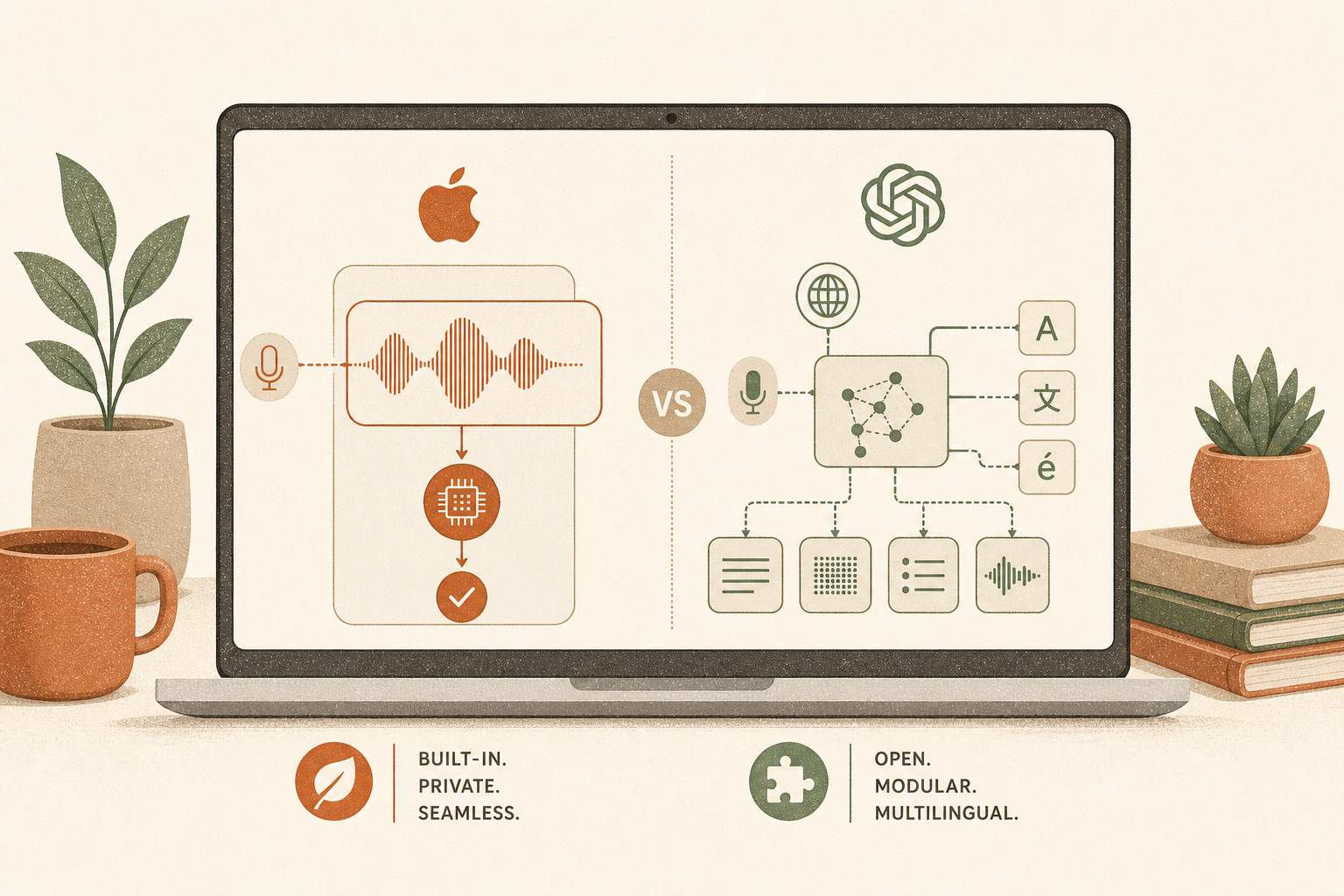
When Apple shipped macOS 26 Tahoe in September 2025, it quietly replaced the decade-old SFSpeechRecognizer API with something called SpeechAnalyzer, introduced at WWDC 2025. [4] Early reports claimed it was faster and more accurate than Whisper, the open-source speech recognition model that has powered most third-party Mac dictation apps since 2022.
The claims are real. An independent benchmark published by Inscribe in July 2026 measured SpeechAnalyzer at 2.12% word error rate on clean English speech, against Whisper Small at 3.74%. [1] That is a 43% reduction in errors, achieved while running roughly three times faster. On a practical 34-minute test file, the MacStories team clocked SpeechAnalyzer at 45 seconds against 1 minute 41 seconds for MacWhisper's fastest model. [3]
But "Apple beats Whisper" is the wrong headline. What actually changed is that Mac dictation now has two strong on-device engines, each built for different jobs. Declaring a winner misses the point entirely.
What the numbers actually say
The Inscribe benchmark is the most credible comparison available. It ran 5,559 LibriSpeech utterances through five engines on an M2 Pro Mac running macOS 26.5.1, using production code paths, all fully on-device. [1]
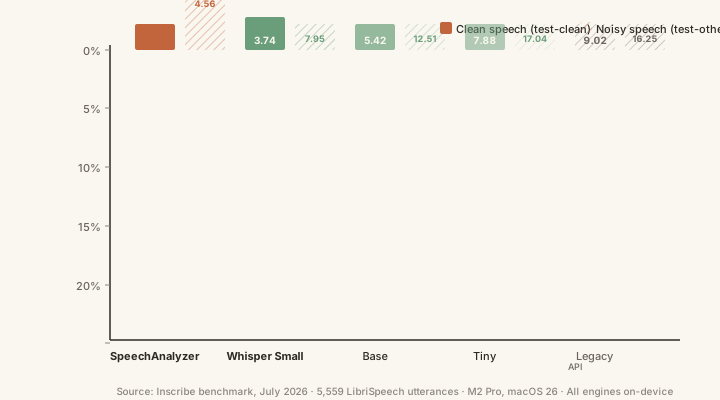
The Whisper columns are independently verifiable. Inscribe reproduced OpenAI's own published Whisper accuracy numbers within a consistent +0.11 to +0.42% offset, which is what you would expect from CoreML quantization. If the harness had measured Whisper incorrectly, the errors would scatter in both directions. [1]
What is perhaps more telling is the legacy comparison. The old SFSpeechRecognizer API scored 9.02% word error rate on clean speech and 16.25% on noisy audio. SpeechAnalyzer is a 3.5 to 4x improvement. Put differently: an hour-long meeting transcribed with the legacy API contains roughly four times as many incorrect words as the same meeting through SpeechAnalyzer. [1] If your current setup uses the old Apple API for anything longer than a voice command, upgrading to SpeechAnalyzer is not a marginal gain. It is a different product.
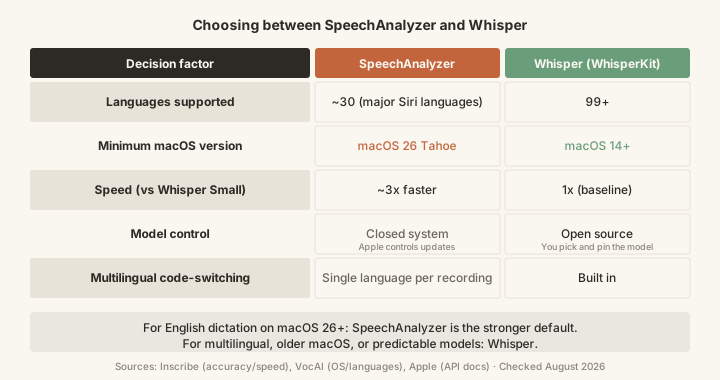
Speed tells a similar story. SpeechAnalyzer ran about 3x faster than Whisper Small per second of audio. [1] The MacStories hands-on test backed this up: their Yap tool, built on SpeechAnalyzer, ripped through a 34-minute 4K video in 45 seconds, compared to 1 minute 41 seconds for MacWhisper's Large V3 Turbo model. [3] That is 2.2x faster on real-world media, not a synthetic corpus.
Where Whisper still wins
The accuracy and speed wins are real across all the available data, but they apply to a specific scenario: English dictation on a current Mac. Whisper holds three advantages that SpeechAnalyzer cannot currently match.
Languages. Whisper supports 99+ languages from a single model, with native multilingual code-switching. SpeechAnalyzer covers roughly 30 locales, aligned with the languages Apple ships Siri in: English, Spanish, French, German, Italian, Portuguese, Chinese, Japanese, Korean, and a handful more. [2] If your dictation needs include Finnish, Ukrainian, Swahili, or any of the 70 languages SpeechAnalyzer does not cover, Whisper is not a compromise. It is the only option.
OS compatibility. SpeechAnalyzer requires macOS 26 Tahoe or iOS 26. [5] Any Mac sold before late 2025 shipped with macOS 15 Sequoia, and many users do not upgrade immediately. A developer shipping a dictation app today has to decide whether to support macOS 15 at all. If the answer is yes, they are shipping Whisper regardless. The real architectural choice is "WhisperKit on 15, SpeechAnalyzer on 26+" versus "WhisperKit everywhere". [2]
Model control. SpeechAnalyzer is a closed system. Apple can change the model at any time through an OS update, and developers do not get to version-lock. For apps where transcription quality is the product (legal transcription, accessibility software, research tools), that unpredictability is a genuine risk. WhisperKit lets you ship a specific model version and know exactly what users are getting until you decide to upgrade. [2]
What this means if you dictate on a Mac
If you dictate primarily in English and you are running macOS 26, SpeechAnalyzer is the strongest on-device engine available. It is faster, more accurate, and already built into the operating system. You do not need to download a 2GB model file, and you do not need to trust a third party with model updates.
If you dictate in multiple languages, run an older version of macOS, or need a transcription model that behaves predictably across updates, Whisper remains the better fit. These are different tools for different jobs.
The most interesting outcome is not that Apple caught up. It is that Mac dictation now has genuine competition at the engine level. For years, the choice was between Apple's weak legacy API and Whisper. Now there are two strong options, and the decision depends on what you actually need.
Several dictation apps, including ShoutFlow, currently ship Whisper via WhisperKit because it provides the broadest language coverage and works across macOS versions. As SpeechAnalyzer matures and macOS 26 adoption grows, expect apps to evaluate dual-path architectures where the engine adapts to the user's language, OS version, and dictation context. That is a product decision, not a marketing one, and it will look different for every app.
The one clear recommendation from the data: if your current workflow relies on Apple's old SFSpeechRecognizer, moving to anything modern, SpeechAnalyzer or Whisper, is a 4x accuracy improvement waiting to happen. The benchmark makes that unambiguous. [1]