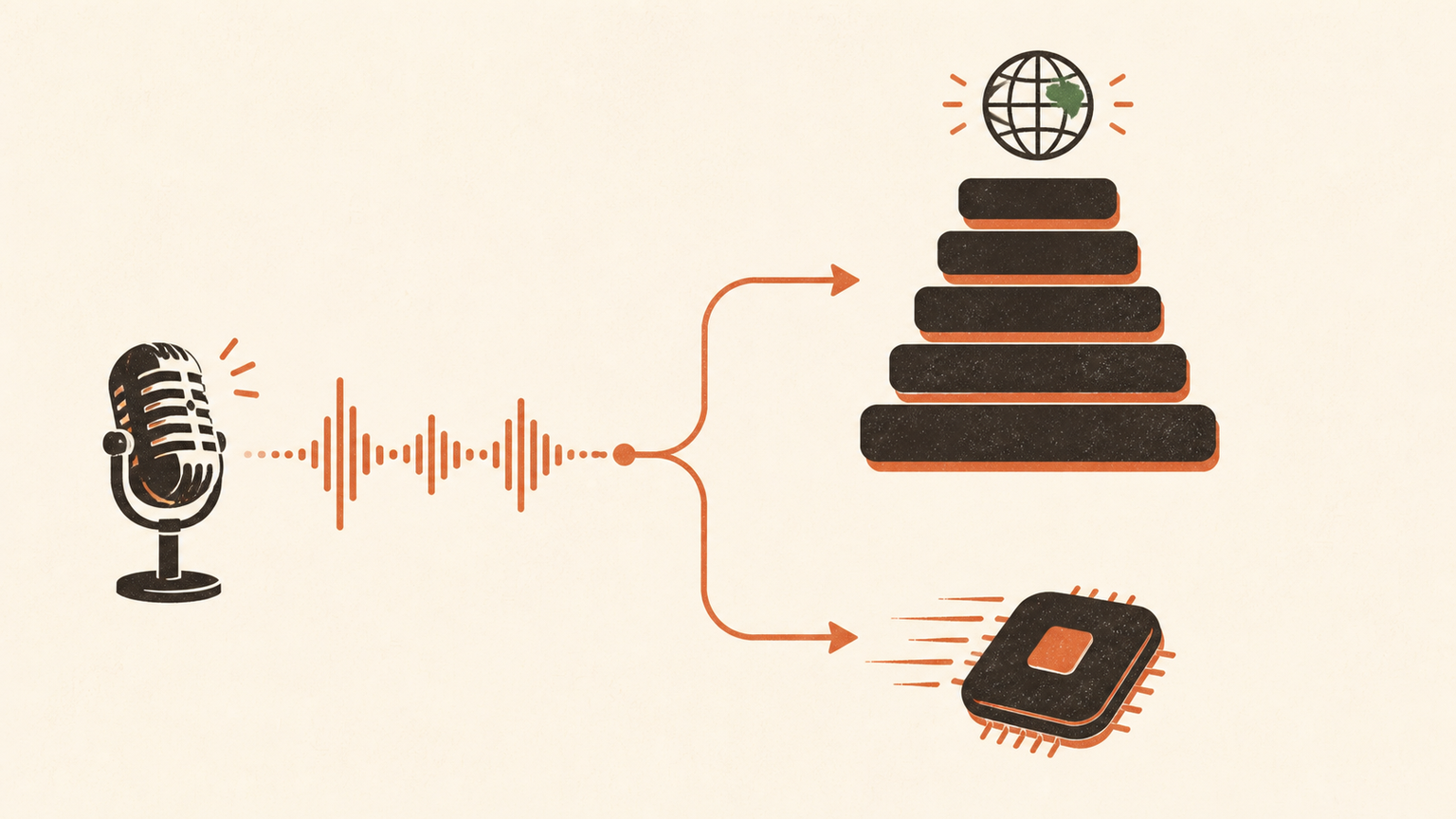
Whisper is the safer default for most Mac dictation users. It covers far more languages, can translate speech into English, and has several established Apple Silicon runtimes. Parakeet is no longer the awkward NVIDIA-only experiment it once looked like, though. It now has usable MLX and Core ML paths on the Mac, and its v3 model covers 25 European languages.
That makes the choice more interesting, but not harder. Start with the job:
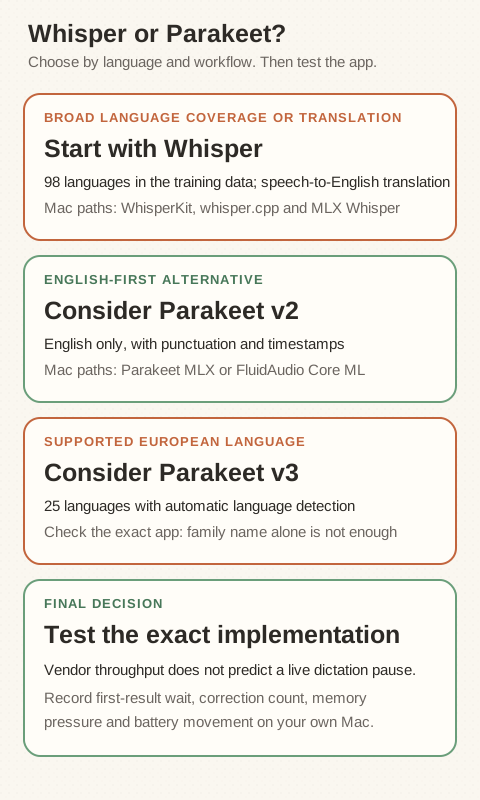
- Need broad language coverage or speech-to-English translation? Start with Whisper.
- Dictating mainly in English, or one of Parakeet v3's supported European languages, and your app has a proper Parakeet implementation? Test Parakeet as well.
- Choosing between two apps rather than two command-line tools? Judge the complete app. The model name alone tells you remarkably little about the wait after you stop speaking or the corrections left behind.
Whisper is still the low-risk starting point
Whisper was trained for multilingual recognition, speech translation and language identification. OpenAI lists six model sizes, from tiny through large, with speed, memory and accuracy trade-offs. Its model card says the non-English training data covers 98 languages, although performance varies substantially by language. [1] [2]
On a Mac, you are not limited to OpenAI's original Python implementation. WhisperKit packages Whisper for Swift and Core ML, while MLX Whisper provides a separate Apple Silicon path. whisper.cpp is another mature local runtime. If the runtime choice is the part you are stuck on, our WhisperKit vs whisper.cpp vs MLX guide deals with that layer separately. [7] [8]
This maturity matters more than it sounds. A dictation app needs audio capture, voice activity detection, chunking, model warm-up, insertion into the active text field and sensible error handling. A good model inside a poor loop still feels poor.
Whisper also gives you a wide model ladder. A smaller checkpoint can reduce memory and waiting time; a larger one may reduce corrections on difficult speech. There is no equivalent promise that one Whisper size will suit every Mac or accent. You still have to test it.
Parakeet now has a real Mac story
The old summary was simple: Parakeet was an NVIDIA model, so using it on a Mac meant wrestling with a community conversion. That summary is now out of date.
Parakeet MLX is a maintained Apple Silicon implementation with a command-line tool, Python API, long-audio chunking and a streaming interface. Its current default is Parakeet TDT 0.6B v3. FluidAudio takes a different route: Swift, Core ML and models prepared for Apple devices, with the work pushed towards the Apple Neural Engine where the model permits it. [5] [6]
Those are credible deployment paths, not proof that Parakeet will be better in your dictation app. They do change the question. You are no longer comparing "native Whisper" with "Parakeet somehow forced through CPU-only ONNX". You may be comparing WhisperKit with FluidAudio, or MLX Whisper with Parakeet MLX. Runtime engineering sits inside the result.
The distinction matters when evaluating apps too. An app saying "Parakeet" does not tell you whether it uses v2 or v3, MLX or Core ML, batch transcription or a streaming model. Look for the exact model and runtime. If the app does not disclose them, treat its own live trial as the evidence.
Which Parakeet version are you actually comparing?
Parakeet TDT 0.6B v2 is an English model. NVIDIA says it includes punctuation, capitalisation and word-level timestamps. Its published average WER of 6.05% comes from the Hugging Face Open ASR Leaderboard, using greedy decoding across named benchmark datasets. NVIDIA's headline RTFx figure was measured with a batch size of 128 on supported NVIDIA hardware. That is throughput evidence, not a measurement of the pause after one person stops dictating into a Mac. [3]
Parakeet TDT 0.6B v3 is multilingual. NVIDIA lists 25 European languages, automatic language detection, punctuation, capitalisation and timestamps. The v3 model card reports a 6.34% average English WER on the same leaderboard set, alongside separate multilingual results. That small difference does not make v2 the universal "more accurate" choice, and it certainly does not predict your accent, vocabulary or microphone. [4]
Whisper still has the broader language remit and can translate supported speech into English. Parakeet v3 narrows the gap for European-language transcription but does not replace that translation capability. [1] [2] [4]
This is why family-level claims age badly. "Parakeet is English-only" was true of v2. It is false of v3. "Whisper is multilingual" is true, but not every small checkpoint performs equally across languages. Write down the full model identifier before comparing anything.
Accuracy tables do not settle live dictation
Word error rate is useful when the dataset, normalisation and decoding setup match. It is much less useful when a model card's number is copied into a comparison as if it were a universal score.
Dictation adds failure modes that a leaderboard can miss:
- a proper name is wrong every time;
- the transcript is accurate but arrives too late to keep speaking naturally;
- punctuation is technically present but creates more editing than it saves;
- the app drops the beginning or end of an utterance;
- a warm model feels quick, while the first use after launch does not;
- memory pressure becomes noticeable during an ordinary workday.
NVIDIA itself notes that Parakeet accuracy varies with language, accent, noise, domain and speech type. OpenAI's Whisper model card also shows large variation across languages and datasets. Neither source publishes the one result you need: your voice, through your chosen app, on your Mac. [2] [3] [4]
Do not convert model-card throughput into live latency. Batch size, hardware, preprocessing, chunking and whether model loading is included can all move the number. A vendor's 100x or 3,000x real-time figure can be perfectly valid for its test and still be useless for predicting a dictation pause.
Run a ten-minute test that resembles your work
Use the same Mac, microphone and app settings for both engines. Warm each model once, then run three short scripts:
- A normal paragraph in your everyday speaking style.
- A paragraph packed with names, product terms, dates and numbers you actually use.
- An awkward sample with a restart, a self-correction and a short pause mid-sentence.
Record four things:
| Check | What to record |
|---|---|
| First result | Time from finishing the first utterance to usable text |
| Warm result | The same timing after the model is already loaded |
| Corrections | Words and punctuation you genuinely had to change |
| Resource cost | Memory pressure, fan noise and battery movement during the session |
A stopwatch and a correction count are enough. Do not build a laboratory around a choice that your own paragraph can settle.
Keep the transcript examples. If one engine misses the same surname three times, that is more useful than a tiny difference between unrelated leaderboard averages. If one is slightly less accurate but feels immediate, you may still prefer it for short replies. For long-form drafting, the correction burden may matter more.
The practical decision
Start with Whisper when you want the widest language coverage, translation, multiple model sizes or the least surprising Mac integration path.
Test Parakeet when your language is supported and the exact app uses a current MLX or Core ML implementation. Parakeet v2 remains a sensible English-specific candidate; v3 is the version to inspect for supported European languages. Neither deserves a win based on an NVIDIA GPU benchmark copied into a Mac article.
Then stop reading model comparisons for ten minutes and dictate something difficult. The better engine is the one that leaves you with less waiting and less repair in the app you will actually use.